
Challenge
In a recently published study, the teams at AstraZeneca and Daiichi Sankyo found that the Spatial Proximity Score (SPS), an in situ measurement of the bystander effect, was a better predictor of response to Enhertu (trastuzumab deruxtecan) than just antigen expression (HER2) alone1. They found that the HER2-low or -negative subgroup could be further segmented into ‘SPS-high’ and ‘SPS-low’ scores. The SPS-high group benefited from the drug even when expression of the drug target (HER2) was low or negative (Figure 1), primarily due to the ADC-specific mechanism-of-action (MOA) known as the bystander effect.
To enable ADC developers to improve their patient selection strategies and derisk late-stage trials, we have developed a similar SPS-based analysis, to establish a scalable, AI-augmented model for scoring the bystander effect and accounting for its impact on biomarker development.
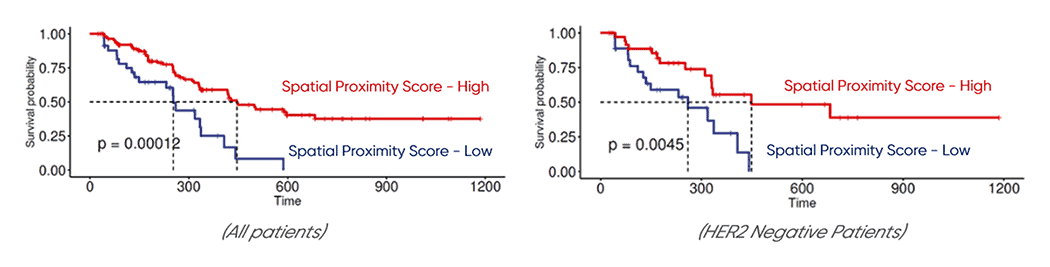
Figure 1. Kaplan-Meier Analyses from the AstraZeneca-Daiichi study showed that Spatial Proximity Scoring could predict progression-free survival across multiple patient sub-groups, including HER2 negative patients [IHC 1+, IHC 2+/ISH- and IHC 0] 1.
Solution
We have developed a framework to score the bystander antitumor activity of ADCs, which affects both antigen-positive tumor cells and antigen-negative tumor cells within a specific radius from an antigen-positive cell (Figure 2). Based on this definition of an ‘affected cell’, the proximity score reflects the proportion of affected cells as a percentage of all tumor cells. AI-augmented SPS allows quantitative scoring of tissue structure, accounting for tissue heterogeneity, tumor architecture, and staining intensity and variability.

Using this framework, we have created a tunable scoring model that can be calibrated to patient outcomes across different patient cohorts. These scoring parameters included:
- Distance (radius) from the negative cell
- Number of positive neighbor cells
- Antigen expression level of positive cells
Reference:
Kapil, Ansh et al. “HER2 quantitative continuous scoring for accurate patient selection in HER2 negative trastuzumab deruxtecan treated breast cancer.” Scientific reports vol. 14,1 12129. 27 May. 2024, doi:10.1038/s41598-024-61957-9
Link to paper >