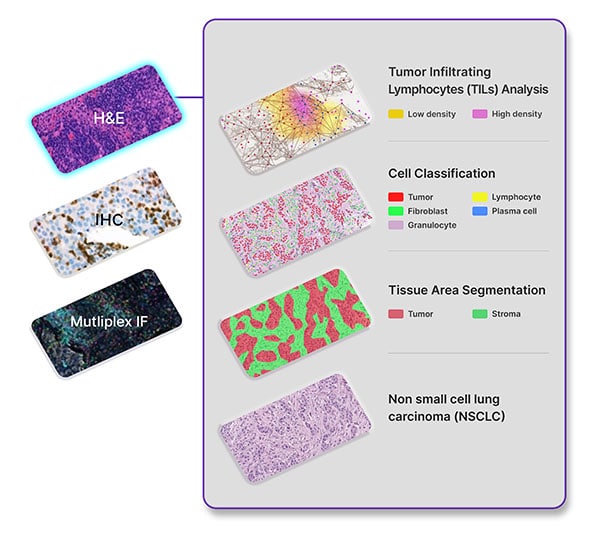
Nucleai, founded in 2018 and based in Chicago and Tel Aviv, is pioneering new ground in spatial biology. Its AI-powered technology provides crucial context for tumor analysis, moving beyond traditional, static biopsy images to highlight cellular interactions that influence disease progression and treatment response.
Innovation, in many cases, happens at the overlap of different domains, and that’s where new things emerge. We’re very fortunate to be at the right timing on that,” explained Avi Veidman, CEO of Nucleai.
The convergence of disparate trends — including advances in AI, improvements in imaging technology and the digitization of biological data — is opening up new frontiers in spatial biology. “By combining digitized biology with AI, computer vision, and machine learning, we can uncover entirely new phenomena,” explained Avi Veidman, CEO of Nucleai. “It’s like having a new scientific instrument — first the telescope to see the stars, then the microscope to see cells, and now AI to unlock the deeper secrets within those cells.”
This approach has practical applications in both drug development and patient care. Veidman elaborates on how their technology works in practice: “Our software platform automatically maps biopsy tissue samples of patients,” Veidman said. Usually, those are oncological patients. “We can then correlate these cellular interactions with other layers of information, whether it’s genomic data or historical electronic medical records.”
In addition to its use in research, Nucleai’s technology is finding use in clinical settings. “We’re the first company where our algorithm is part of an active clinical trial and patient enrollment criteria,” Veidman said.