
PLACE HOLDER IMAGE
Spatial Biomarker Intelligence for ADC Development
Accelerate Development | De-risk Trials | Clinical Deployment | Resources
Antibody-drug conjugates require biomarker strategies that reflect their complex mechanism of action. Nucleai’s AI-powered spatial analysis transforms routine pathology images into quantitative insights that support biomarker discovery, patient stratification, and clinical deployment.
De-risk Clinical Trials
ADC response is influenced by tumor heterogeneity and spatial cell interactions, factors that binary biomarker scoring is not designed to capture.
Nucleai enables pharmaceutical teams to:
- Enrich for tumors spatially compatible with ADC mechanism — using SPS-based enrichment and heterogeneity-aware stratification to support more informed patient selection
- Quantify target heterogeneity, ultra-low expressor populations, and spatial heterogeneity maps — contributing to more efficient trials and stronger response signal detection
- Define reproducible biomarker cutoffs with a mechanistic rationale for patient selection — supporting CDx narrative development and differentiation in crowded target landscapes such as HER2, TROP2, and FRα
→ Further Reading: [Case study title] (link)
Accelerate Clinical Development
Understanding where and how an ADC works is foundational to effective translational strategy.
- Deeper Understanding of Disease MoA — Characterize target expression, bystander effect potential, and tumor microenvironment interactions from early tissue samples
- Quantify Disease Biology & Target Heterogeneity — Map intratumor expression patterns and spatial relationships across the full intensity spectrum — beyond what binary scoring captures
- Enable Rapid Hypothesis Testing — Explore thresholds, spatial parameters, and biomarker cutoffs against clinical outcome data in analysis-ready formats
→ Further Reading: [Case study title] (link)
Clinical Deployment & Capanion Diagnostics
Getting from biomarker discovery to clinical use requires process rigor, not just analytical performance.
- Algorithm Deployment Under Design Control — Algorithms developed under QMS and design control frameworks to support prospective trial enrollment and CDx co-development
- CDx Ecosystem Integration — Compatible with Roche Navify, Leica HALO, and Agilent Proscia — deployable on-premise or cloud, within existing clinical lab workflows
- Clinical Scoring at Scale — Quantitative, reproducible scoring across sites and platforms, with pathologist-interpretable outputs designed to support regulatory review
→ Further Reading: [Case study title] (link)
The Nucleai Solution
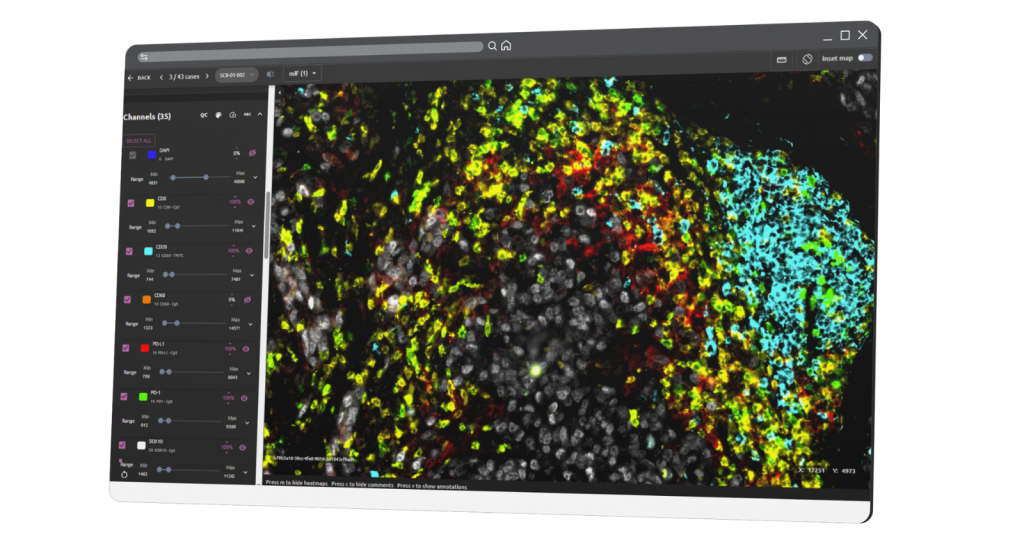
Nucleai combines advanced deep learning with spatial biology analysis to extract quantitative insights from routine pathology images.
Platform capabilities include:
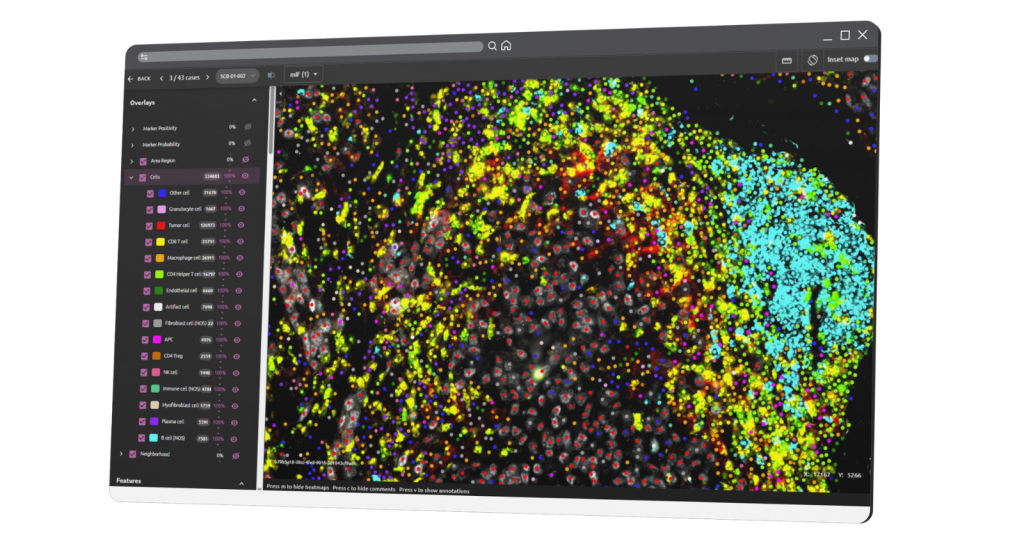
- Cell detection and classification using deep learning models
- Tumor microenvironment segmentation and structural characterization
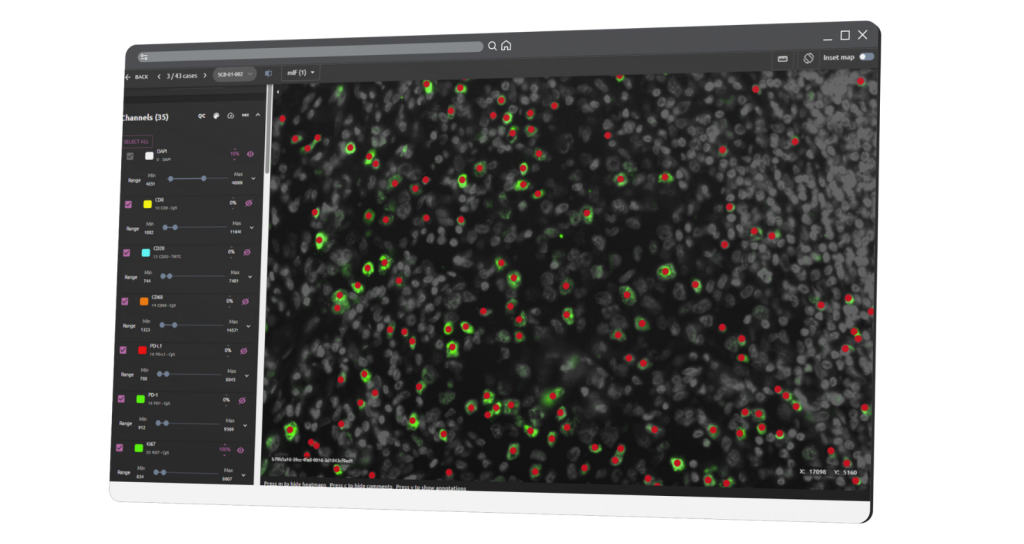
- Optical density–based quantitative scoring per cell compartment (membrane, cytoplasm, nucleus)
- Spatial proximity analysis, neighborhood mapping, and Spatial Proximity Scoring (SPS)
- Multiplex biomarker analysis and co-localization assessment
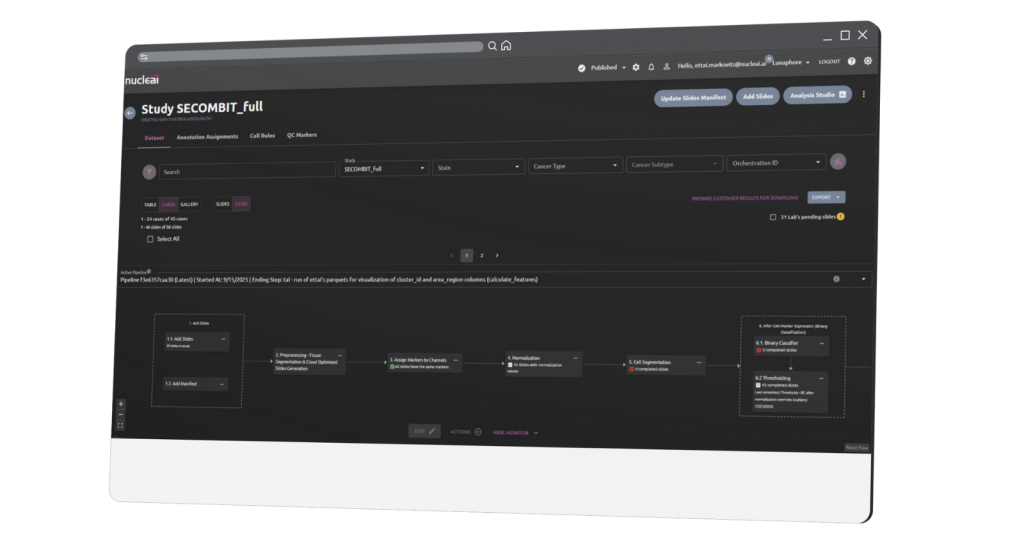
The platform generates rich datasets containing thousands of spatial features that can support deeper characterization of tumor biology and drug response patterns. These insights can inform biomarker discovery, translational research, and clinical strategy across ADC development programs.
Deployment options include cloud-based and on-premise configurations, with structured CSV outputs designed for integration into sponsor biostatistics and translational research workflows
Place holder Image carousel


Further Reading:
Selected publications, webinars, and platform overviews for ADC development teams.

Harnessing AI Pathology to Unlock the Full Potential of ADCs
All eyes are on emerging molecules, new indications, and new biomarkers as we approach the upcoming World Antibody-Drug Conjugate (ADC) 2024 conference this week. ADCs
Beyond Antigens and Bystanders: Exploring Novel ADC Mechanisms
The search for better biomarkers of antibody-drug conjugate (ADC) efficacy just received a “hot tip:” new research reveals that cathepsin L (CTSL), a protease found
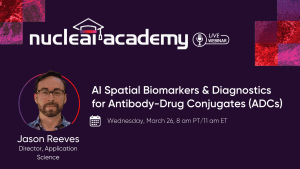
AI Spatial Biomarkers & Diagnostics for Antibody-Drug Conjugates (ADCs)
The mechanism of action (MOA) of the next generation of protein-directed therapeutics are complex and require a new generation of biomarker assays that accurately reflect this complexity. Antibody-drug conjugates (ADCs), multi-specifics, and immunotherapy combos increasingly depend on spatial scoring and multiplex detection to predict treatment outcomes.
Advance Your ADC Development Strategy
ADC development increasingly depends on biomarker strategies that can capture the spatial complexity of tumor biology and drug mechanism. Fill in the form below to request a demo.
*Submissions are reviewed to ensure alignment with study scale and workflow requirements.